A story from The Transfiguration · The Life of Christ
The Good Samaritan
A lawyer asks Jesus who his neighbour is. Jesus answers with a parable: a beaten traveller is passed by a priest and a Levite and cared for by a Samaritan. Then Jesus asks which one was the neighbour.
Remember it byA priest and a Levite pass by. A Samaritan stops, binds the wounds, pays the inn and promises to return.
Where it fits
- The Sermon on the Mountc. AD 28
- Good Samaritanc. AD 29
- The Triumphal Entryc. AD 30
This story belongs to The Transfiguration on the timeline, in the era of The Life of Christ (c. 5 BC – AD 30).
The story
-
IThe lawyer's question
Luke 10:25–29
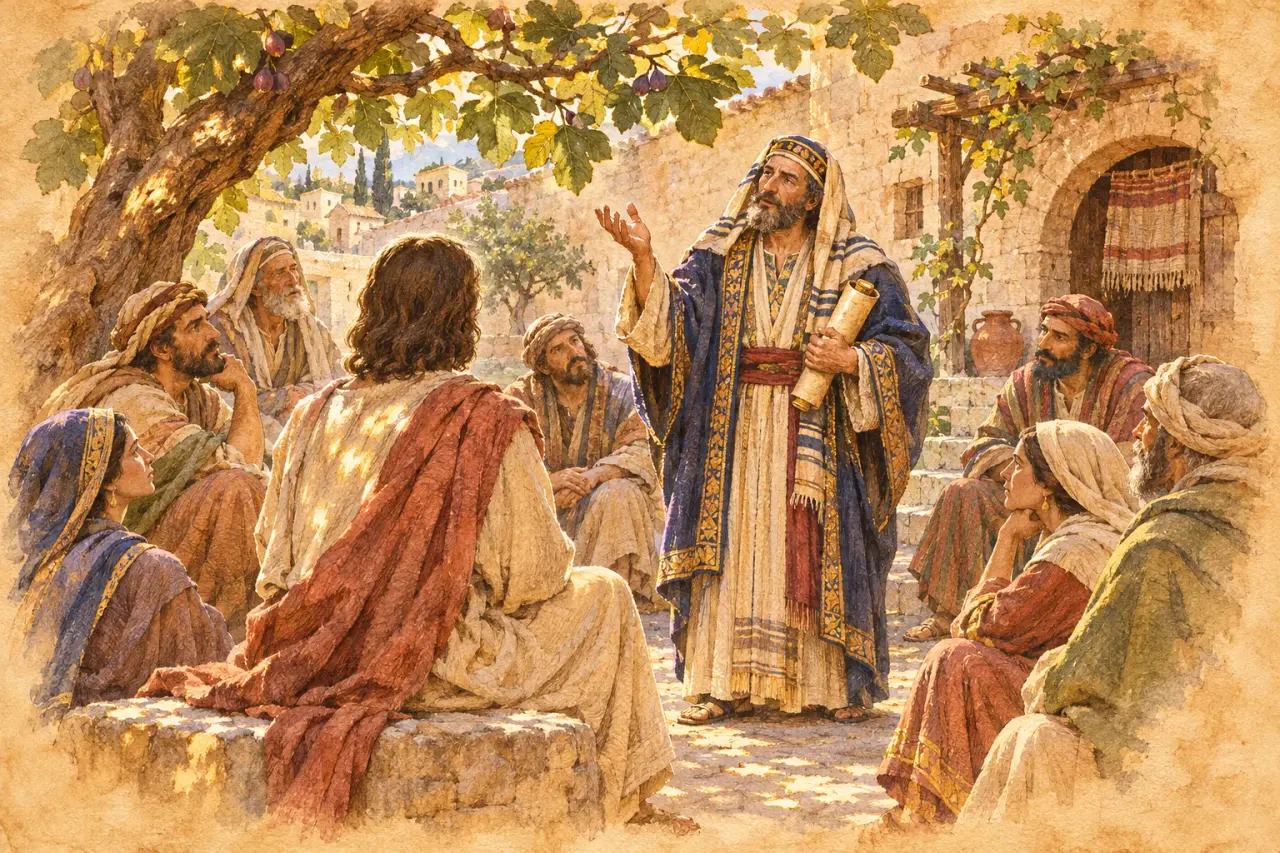
A lawyer stood up to test Jesus. He asked what he must do to inherit eternal life. Jesus turned the question back to him. What was written in the law? How did he read it?
The lawyer answered well. Love the Lord your God with all your heart, with all your soul, with all your strength and with all your mind, and love your neighbour as yourself. Jesus told him he had answered correctly. If he did this, he would live. But the lawyer wanted to justify himself, so he asked one more question. Who is my neighbour? Jesus answered with a story.
But he, desiring to justify himself, asked Jesus, “Who is my neighbour?”
Luke 10:29 · World English Bible -
IILeft half dead
Luke 10:30–32
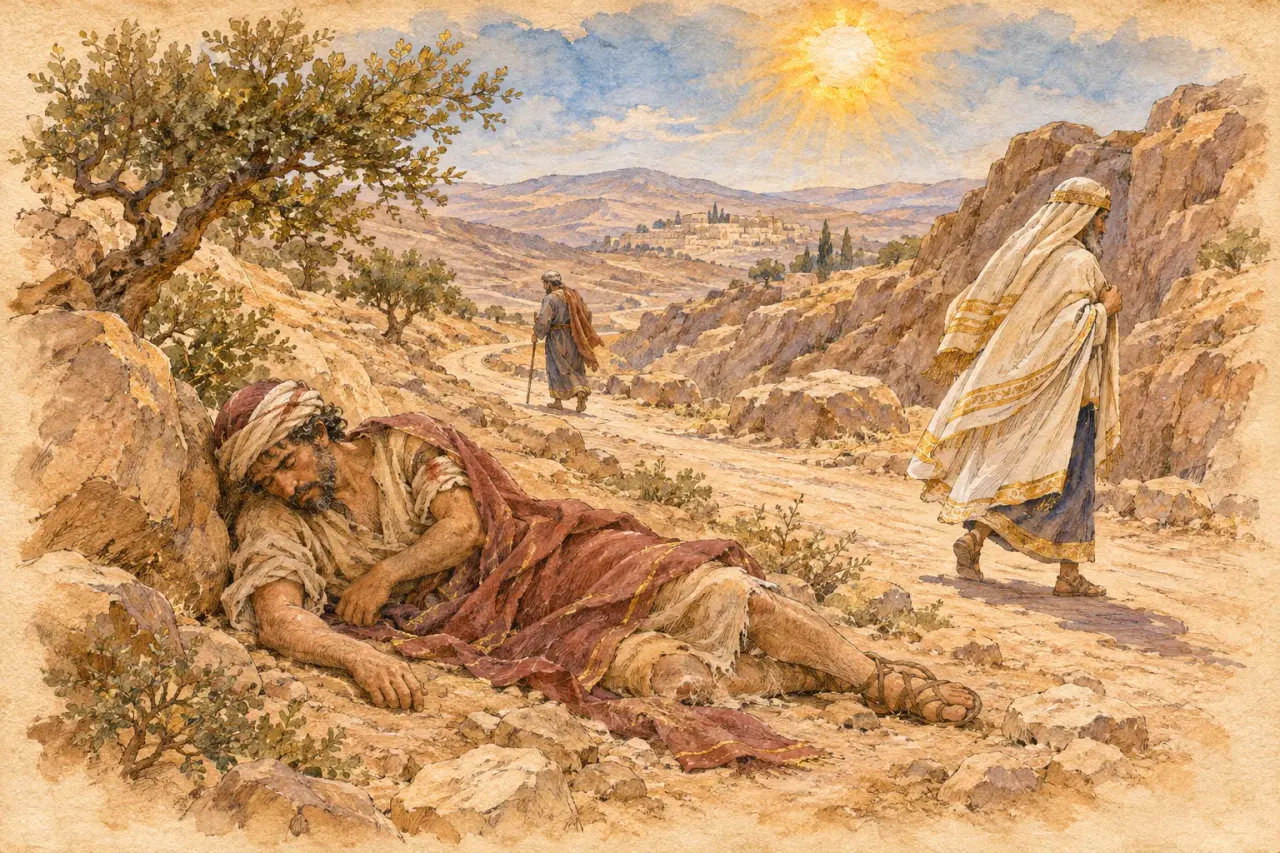
In the story Jesus told, a man was going down from Jerusalem to Jericho when he fell among robbers. They stripped him and beat him. Then they went away and left him half dead.
By chance a priest was going down the same way. He saw the man, and he passed by on the other side. In the same way a Levite came to the place. He also saw him, and he also passed by on the other side. Jesus gave no reason for what they did. Each one saw the man, and each one kept walking.
By chance a certain priest was going down that way. When he saw him, he passed by on the other side.
Luke 10:31 · World English Bible -
IIIThe Samaritan stops
Luke 10:33–34
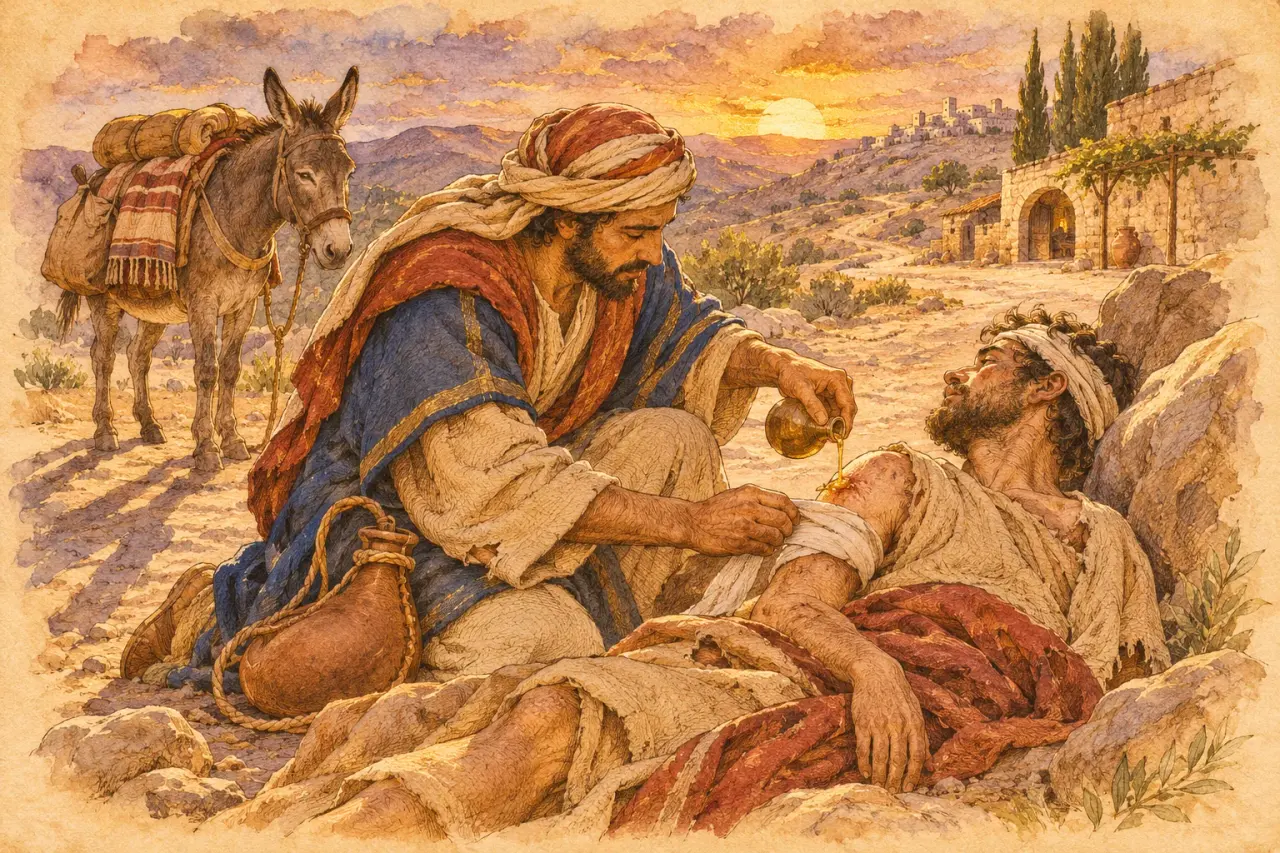
Then a Samaritan, who was travelling, came to where the man was. He was the third traveller to see him. When he saw him, he was moved with compassion. He did not pass by on the other side. He went to him.
He poured oil and wine on the man's wounds and bound them up. Then he set him on his own animal, brought him to an inn and took care of him. Jesus built the picture out of small actions, one after another. The Samaritan saw, he came, he bound, he lifted, he brought, he cared.
But a certain Samaritan, as he travelled, came where he was. When he saw him, he was moved with compassion, came to him, and bound up his wounds, pouring on oil and wine. He set him on his own animal, brought him to an inn, and took care of him.
Luke 10:33-34 · World English Bible -
IVGo and do likewise
Luke 10:35–37
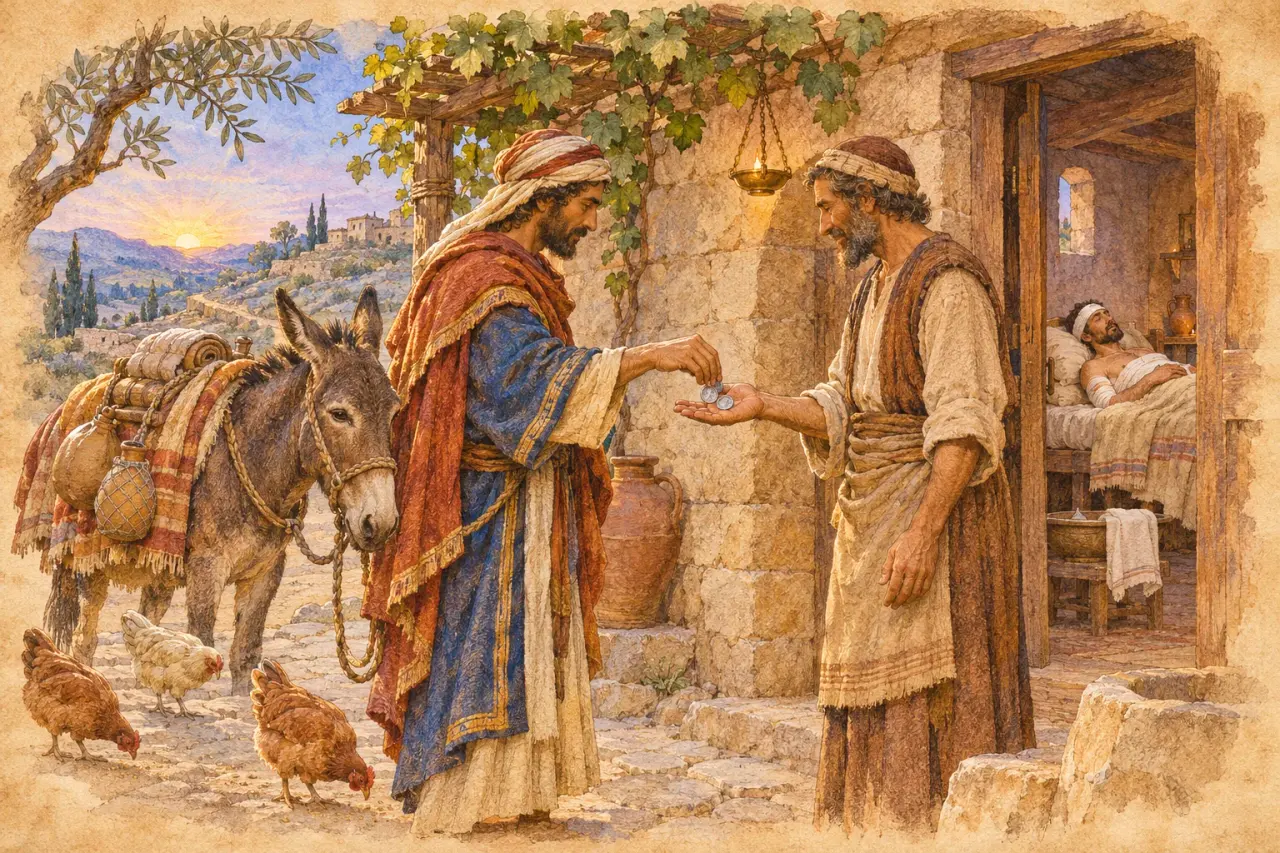
The next day, when the Samaritan left, he took out two denarii and gave them to the innkeeper. He asked him to take care of the man. Whatever more the innkeeper spent, he would repay it when he came back. There the story ended.
Then Jesus asked a question of his own. Which of these three seemed to be a neighbour to the man who fell among the robbers? The lawyer had asked who his neighbour was. Jesus asked who had been a neighbour. The lawyer answered that it was the one who showed mercy on him. Jesus told him to go and do the same.
Now which of these three do you think seemed to be a neighbour to him who fell amongst the robbers? He said, “He who showed mercy on him.” Then Jesus said to him, “Go and do likewise.”
Luke 10:36-37 · World English Bible
Key verse
He answered, “You shall love the Lord your God with all your heart, with all your soul, with all your strength, and with all your mind; and your neighbour as yourself.”
Luke 10:27 · World English Bible
How it fits the whole story
The lawyer already knows the two great commands, to love God and to love his neighbour (Deuteronomy 6:5 and Leviticus 19:18). What he wants is a limit. Jesus tells him a parable in which the one who helps is a Samaritan, at a time when Jews had no dealings with Samaritans (John 4:9). By the end the question has changed. It is no longer who counts as my neighbour, but whether I am a neighbour to the person in front of me. Mercy that costs time and money is what love for a neighbour looks like.
Read it in Scripture
The telling above is a summary. Here is the passage itself, from the World English Bible.
Luke 10:25-37
25Behold, a certain lawyer stood up and tested him, saying, “Teacher, what shall I do to inherit eternal life?” 26He said to him, “What is written in the law? How do you read it?” 27He answered, “You shall love the Lord your God with all your heart, with all your soul, with all your strength, and with all your mind; and your neighbour as yourself.” 28He said to him, “You have answered correctly. Do this, and you will live.” 29But he, desiring to justify himself, asked Jesus, “Who is my neighbour?” 30Jesus answered, “A certain man was going down from Jerusalem to Jericho, and he fell amongst robbers, who both stripped him and beat him, and departed, leaving him half dead. 31By chance a certain priest was going down that way. When he saw him, he passed by on the other side. 32In the same way a Levite also, when he came to the place and saw him, passed by on the other side. 33But a certain Samaritan, as he travelled, came where he was. When he saw him, he was moved with compassion, 34came to him, and bound up his wounds, pouring on oil and wine. He set him on his own animal, brought him to an inn, and took care of him. 35On the next day, when he departed, he took out two denarii, gave them to the host, and said to him, ‘Take care of him. Whatever you spend beyond that, I will repay you when I return.’ 36Now which of these three do you think seemed to be a neighbour to him who fell amongst the robbers?” 37He said, “He who showed mercy on him.” Then Jesus said to him, “Go and do likewise.”